
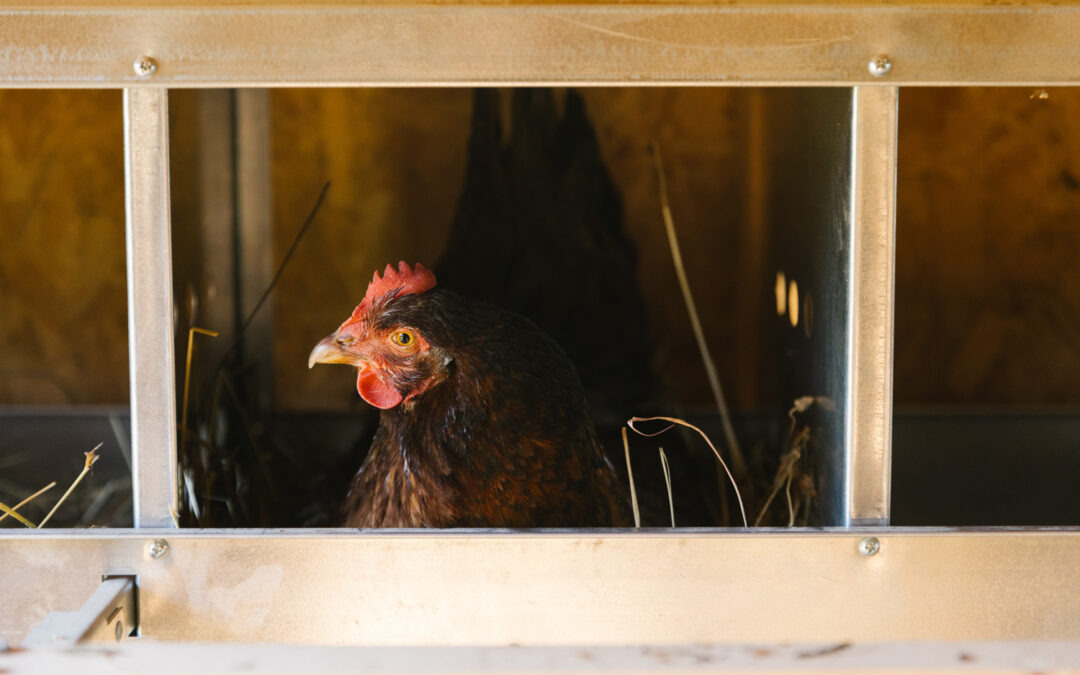
Are your chickens laying fewer eggs recently? We know it can be frustrating to have a large flock of chickens and find little to no eggs in their nest boxes. There are a plethora of reasons why the egg laying rate of your flock of chickens is dropping. We’ve compiled a list of the top 10 reasons why your hens aren’t laying eggs, along with some suggestions on what you can do to help ensure that they lay their best.
 1. Lighting
Now that Spring is approaching, and the days are getting longer, the hens in my home flock have started laying again. During the early part of the winter, they were laying fewer eggs because there were fewer daylight hours.
Hens need 14 or more hours of daylight each day to lay well. During late fall and winter, particularly from October through February, they won’t receive that many hours of daylight naturally. You have a choice, you can either let them take a break from laying or provide additional lighting.
 Are your chickens laying fewer eggs recently? If you haven’t made any big changes to how you’re caring for them, there’s a good chance the lack of eggs is caused by the shorter daytime hours.
Chickens need a full 14-16 hours of daylight each day to lay their best, and this time of year, they won’t receive enough anywhere in the Northern Hemisphere.
The amount of daylight per day begins decreasing around the middle to end of June, and will continue to decrease until around Christmas. Around the end of September, everywhere in the United States and Canada receives less than 12 hours of daylight each day. Even if you account for some sunlight reaching your chickens slightly before sunrise and slightly after sunset, they’re still getting less than 13 hours of light in October, unless you’ve added supplemental lighting in their coop.
Chickens don’t need a lot of light in order to lay. Some breeds, like the leghorn, can lay well with just 1/2 footcandle (fc) of light. To get an idea how bright that is, try reading a newspaper in dim light. If you adjust the lighting so that you have barely enough to read it, that is about 1/2 fc. Heavier, dual purpose breeds need 2 to 5 fc to stimulate laying.
If you decide to add supplemental lighting to keep your flocking laying well through the winter, you can use an outlet timer and a safe poultry lamp. It’s best to set the timer so that the light comes on in the morning before dawn, to give at least 14 hours. You could also add light at dusk instead, but that approach doesn’t work as well in practice because when the lights go out in the evening the coop will get dark immediately. This makes it harder for the chickens to find a good place to roost. For tips on lighting safely, see our article Preparing Your Laying Flock for Winter, Part 2.
2. Stress
Stress can cause your hens to stop laying. What causes them to have stress? Allowing them to get frightened or handled to much, letting them run out of food or water, moving them to a different pen or coop, or disrupting their pecking order can all cause stress.
3. Feed
Laying hens need a balanced diet to lay well. Good quality layer feeds have the correct balance of protein, carbohydrates, vitamins, calcium and other minerals. If you feed table scraps or scratch grains to your hens, you should use moderation so as not to upset the balance.
4. Water
Chickens should always have access to clean water. In the winter, take precautions to make sure their water doesn’t freeze.
5. Diseases or Parasites
Diseases or parasites can slow or stop laying. The Chicken Health Handbook (Damerow) is a good source of information on this topic.
6. Temperature
Hens lay best when it’s not too cold or too hot. If possible, keep the temperature in their coop above 55° F in the winter. During the summer, provide plenty of shade and cool water.
7. Molting
Chickens will molt about once a year and usually slow or stop laying eggs during that time. The molt will last from two to six months.
8. Broodiness or Hiding Eggs
8. Age
As your hens get older, they will lay less frequently. Usually, they lay best during their first and second year, then as they approach three years old, their laying will decrease. By the time they’re about five years old, they’ll only be laying about half as frequently as they did at their peak. Raising a new flock every few years is the best way to have an ongoing supply of home grown eggs.
9. Missing Eggs
Predators such as skunks and snakes will eat eggs. Prevent this by gathering the eggs more frequently, and improve pens and housing as needed to keep the predators out.
Another reason you might not be seeing eggs, could be your hens are laying elsewhere. This can be due to predators, snakes or rodents in the coop; or hens sneaking off laying elsewhere due to overcrowding in the nest boxes, your hens are sitting on a clutch of hidden eggs, or they just like it better somewhere else.


Why would an Americana quit laying blue eggs?
Cindy, we aren’t sure why your Americana would stop laying blue eggs. Egg color is genetically determined by the male parent of the hen. A hen will normally lay only one color of egg her entire life, but the egg shell color may fade as the hen grows older.
Hi everyone,
I have 6 layers … three cochins (laying very well) one NH and two Rodies … Not laying since Dec!! I do have my old hen Justine … she is 10! Yes 10 … she laid till she was 7! However the 2 one yr old reds still haven’t laid since Dec after molt … I’ve had layers for years and have always had healthy, well watered, proper food, proper light (even in Alaska) heat, and they get out of the coop to roam at five everyday … very spoiled and well taken care of … If the cochins resumed laying after 2 wks in Dec… why didn’t the reds? I know egg laying is a “process” and not by choice but… could they not be laying just because Justine isn’t? Do I need a “chicken psychologist”? Or do “I” need one? hee hee… Just wondering why they aren’t laying and all is well in the coop with no diseases…
Puzzled in Alaska
I had a hen once that waited until I let her out every night to lay in my side yard. I didn’t know she was laying in the side yard until I happened across the eggs, about 10 eggs. Maybe your hens are laying at 5 everyday, when you let them out. Rhodes are really good layers, check your yard you might find them somewhere. I also want to comment on your 10 year old chicken, That is amazing. Had no Idea a chicken could live for 10 years. Congrats on that; you must be good to your hens!!!!!
Why does cider vinegar help stop chickens from pecking each other?
I have a 10 week old Blue Hamburg hen named Road Runner. Today I noticed that she was limping after she came in from her time outside. She also can’t stand on it for a long time or she will collapse, strangely she can still run, but not as fast. if I leave her leg alone do you think it will get worse. (Also I separated her from the other hens so they wouldn’t hurt her).
Confine her in a small area to give the injury time to get better.
Egg eaters are #10 – hens that destroy eggs
My 28 week old hen is harassing my 8 week old chicks. Do you think it’s too early for them to be put in the same coop together? Also when I don’t put the chicks in the coop with the hen and let the hen and the chicks free range, the hen will chase them, and now the chicks are terrified of the hen, what should I do?
The 8 week old chicks should be housed separately from the 28 week old hen. Once the chicks reach maturity, then you may be able to combine them with the adult hen.
There are some good tips on how to do this (using a temporary barrier) in the comments below this article: Should I Feed My Chickens Oyster Shells.
I always put in a separate pen, but put them where they can see each other. At 10-12 weeks I put them together for small amounts of time. When they show signs of fighting I separate. doing this for a couple week, by 10-12 weeks their fine together. There is always one or two bullies in every flock. And remember some pecking order has to be done for every one in the flock to get along.
My Golden Buff started laying a egg a day at 23 weeks old, but now she is starting to slow down at 28 weeks old. This week she only laid 5 eggs. I noticed that last week and the week before that she missed a day too, but now she’s missing 2 days a week. Could this be a sign of sickness? I also been introducing her to the younger chickens we have do you think the younger chicks could be stressing her out causing her to lay fewer days.
It’s possible an illness could be involved, but the other things we mention in the article are also possible causes. If you suspect an illness, The Chicken Health Handbook is an excellent source of information about diseases, parasites, and matters that affect and relate to chicken health. It would be a useful resource to you in diagnosing the cause.
Predators, such as snakes and skunks are common this time of year and will eat eggs. Sometimes, there is a trace you can look for, such as broken egg shells near or even some distance from the coop or pen. Chickens can develop a bad habit of eating eggs. You may want to investigate closely to see if either of these two possibilities are occurring.
If you are feeding too much scratch grains or table scraps in addition to a good quality commercial feed ration, this can result in a nutrient imbalance that could affect laying. Insufficient water can slow or stop laying also.
For more information about raising chickens, we recommend Storey’s Guide to Raising Chickens.
Buffs are not the best layers. Every Buff I have had has only layed about 5 eggs a week, 6 sometime in spring. Even Leghorns (I have had) miss a day every 3 days or so.
I have 14 hens and one rooster. (I’m new at this amazing adventure) When will a hen start to brood? How do you know? Anything special she will need? I’m looking forward to new chicks. Also some hens and the rooster are having feathers pulled out. I have lights, never out of water/feed, they have access to outdoors, and I entertain them (hanging cabbage, bagels etc.) during bad weather, so why are some getting pecked at? They are various breeds, and I get 10 – 12 eggs most days.
Paula, not all chicken breeds will go broody. Once a hen has started laying, she may go broody and set on a nest of eggs. If you find a setting hen, the best way to tell if she is broody is to reach under her to try to remove the eggs. If she pecks at you, puffs out her feathers, and clearly seems to be very bothered by you disturbing her, then she is broody.
The pecking problem that is causing the feathers to be pulled out could be from deficiencies in the diet, boredom, overcrowding, or it may be simply a bad habit that has developed. We recommend that you keep the flock on a good quality layer feed, with fresh water available to them at all times. You may also want to add a vitamin supplement to the water. If you notice an aggressive bird who seems to be instigating the pecking, you can separate that bird from the others. As a last resort to prevent pecking, you can trimming the top beak of each bird.
As for the broody hen, she will make a noise, blup blup blup blup blup many time when you look in to get eggs. If you try to grab the eggs she will scream at you and maybe even bite you. Some hens will bite when setting on eggs even if not broody, but the blup blup blup blup blup sound is a sure sign. They may even loose their chest feathers.
For the feather plucking, I have found that when a hen molts she looses feathers, and before the feathers have a chance to come back all the way, the other hens may pluck them out, thinking the feather is a bug or something. I try to let them stay and protect themselves during the growing back of the feathers. But, sometimes I have to separate the hen until her feathers are all back. Then all is fine.
I live in the Northern part of Michigan’s Upper Peninsula. I have a tractor style bottomless coop, and I used no heat for the winter except for a 100 watt bulb on a timer during the day (7 AM to 10 PM so that the crowing doesn’t wake the neighbors). Now that it’s warming up I replaced it with a CFL. I have a small covered run that they can go into any time and where I keep the food and a heated waterer. The coop is really two coops pushed together with a small door connecting and nests on one side, perches on the other. During the day they have the run of a 20 X 30 garden and they go out in most kinds of weather. I kept about half of the garden shoveled down to a snowpacked level “yard” and they mostly kept to that, but they’ll go up on the snowbank and even wade into deep snow if I put the dish up there when I’m filling it. Now that the snow is crusty and melting, they go everywhere. I have 20 hens and two roos, one of which I separated from the flock because too many hens were getting “barebacked”. I feed organic feed supplemented with sprouted grains and legumes and excess organic veggies and greens from the garden. I got 16-18 eggs/day all winter long, but right now I’ve let a couple go broody, so I sometimes get as few as 13 but still 17 some days. My flock was purchased as chicks last May.
I have 30 hens and two roosters. I’m currently only getting one egg a day. I’ve been trying to figure out which hens aren’t laying. I know I have some older hens, just don’t know which ones since I get new chicks every year to add to the flock. I’ve been told to do the “two finger test”….If there isn’t two finger’s width between their little pelvic bones (not sure that’s what they are called), then they aren’t laying. I’ve checked a few of my hens. Some are barely one finger’s width and some are over two. Is this an accurate method? I hate to “convict” the innocent. I’ve been keeping a heat lamp in the coop since it’s been freezing and it’s been on 24/7. Thanks.
Susie, in addition to checking the pelvic bone spacing, there are a several other things you can look for to determine whether a hen is laying well. As a hen lays, her yellow skin will get bleached to a pale pink or whitish color around the vent area. If she’s been producing eggs for a long time, even her shanks will be bleached. The vent of a good layer will also be large and moist. If you have a copy of Storey’s Guide to Raising Chickens, please see pages 195-196 for a good description of what to look for.
I’ve used the finger test and I think it does help you make a pretty good educated guess. I also try to feel if the bones feel stiff or flexible. I think if the bones is to rigid it won’t lay as well if at all.
Hope this helps!
Becky
Susie,
I have had chickens for over 30 years now. No mater what you do they will slow down a bit in winter. However 30 hens and one egg a day is a bit extreme. If you have been providing lighting as described, then rule out disease next. If they are healthy, do not frequently run dry of water and food, then my hunch is a little dip in their nutrition. This is no fault of yours and they likely just need a little boost in protein and calcium. Your local feed supply should have a grain with a higher protein content. If the fat content is a little higher in that grain, don’t worry about it. Also introduce some crushed calcium for a few weeks, and threaten them by telling them they will become soup if they don’t start laying. :-)
They should start laying better after 2-3 weeks. Good luck.
I love my chickens, too. I give them a lot of table scraps, no animal fat! I also mix it up with their feed and an occasional crushed egg shell(s). I enjoy sitting and watching them from time to time. I keep a chair in their area for just that purpose. I have three hens, and five roosters for now. I keep the roosters separated from the hens for now, too. There are nine chicks from a previous brood, and the hen is still very protective. She is a tan bantam. I adore her little fluffy feet! I lost all of my chickens last year or so from predators, foxes, raccoons and opossums. It has been eight months and nothing has come – must be the mine field I put in. HA. I think the bantams eggs are must tastier than regular eggs. I consider them my pets and would not ever consider killing any of them, although – one particular rooster came pretty close to going to that big coop in the sky last month – he has since been de-thorned. (ha) I have started making earrings from their hackle feathers – some have turned out beautiful and I have sold a few pair. My husband has promised to make me a better area this spring – I want to raise some different types of breeds just for fun. My grandchildren love to feed them, too. May the feathers be with you!
I have had chickens for years and love hearing them in the mornings and letting my children gather the eggs. They love it. We have recently lost all of my big chickens to predators. We all cried. They were our pets, especially one we had named Big Momma. She was a Wyandotte. Beautiful! I had been keeping them in with my banties, but my coop was getting too small, so I put them into the bigger coop that I had spent all day fixing from the last attack. Me and my husband thought it was secure, but they found a small spot that we did not see and came the first night and wiped out the whole flock. I was heart broken. I still miss them! But our banties are doing great!! We have a new start with some chicks. We are building new coops. I dare them to come back again. They will get the shock of their lives. Ha ha.
My hens lay eggs almost year round. I don’t have any Roosters because they keep all the feathers scratch off the hens back. I feed them Corn /scratch feed /laying pellets /and plenty of crushed oyster shells and fresh water. I give them grass clippings. When I cut grass they love it. I keep the pen clean and put in fresh horse hay.
I use an infrared lamp in each of my two coops during really cold weather (below freezing). In the spring I switch to a dawn to dusk red flood light and in the summer I use a dusk to dawn red compact florescent. The red color keeps them from pecking at a wound or bald spot on their roost neighbor and keeps the skunks away. I have a huge number of predators-skunks, badgers, snakes, squirrels, and pack rats. I’ve got a ten foot high fence and the bottom of the fence is chain link buried 18 inches in the ground. Still the diggers make their way in. My ladies lay 2 dozen eggs a day. There are 32 hens and 3 roosters. 8 of my hens are more than 3 years old. They get a lay feed, scratch, and daily hand-feedings of greens in winter and fall. My customers and I think the eggs taste better with the greens. The greens are also a great source of calcium. In summer they get garden weeds and excess greens. They often slack off on laying when it’s very windy. In the rain they lay more and spend more time on the nests. They always lay more when I’ve cleaned out the coop and layed down new wood shavings or grass hay. I only keep roosters that have no or very small spurs. The roosters do keep hawks and ravens from badgering the hens during the day. I live in the country and they have a lot of room to roam. I also keep a couple old tires in the chicken yard that I fill with general purpose sand with a lot of grit in it. They use it to clean feathers and sometimes eat the grit.
I live in North Pole, Alaska and we are up to at least 12 hours of daylight per day. My daughter has one coop that stopped laying in December (all coops have lights and are heated) and they just started laying again this week. (Coop is full of D’Uccles) My other two coops have been laying consistantly all winter (even at 40 below). One is mix of everything and one is mostly Buff Orpington. I did butcher 8 roosters out of each of my coops, and it didn’t change the egg count. My chickens don’t go out at all during the winter so I like to entertain them with blocks of frozen rice and vegetables and heads of cabbage.
I have mainly brown egg laying hens, with about 3 Americana hens. I tend to go long periods of time not seeing any green eggs. I’ve read that they lay a range of colored eggs. My question being will one hen lay more than one color or shade of shell?
I also supplied my hens with a poultry block this winter, they seemed a lot more content. Thanks for such great quality of birds, supplies and information.
Cindy, the egg color will stay basically the same for any particular Americana hen, though the color can fade as she gets older.
We live in the Twin Cities area and have had more than our fair share of snow this winter. We heated our insulated coop with an in-wall electric heater with thermostat and it stayed a “toasty” 50-53 degrees F all winter. Water still froze at times, so we bought a heated dog bowl, and that worked well. We also have a light on a timer to extend “daylight” to 16 hours a day with an LED nightlight so they can see during the night. The girls freely used their attached run all winter. It has a roof so very little snow came in (they won’t set foot in snow), and we used straw on the ground (our soil is all sand) so they were able to scratch and take a dirt bath all winter. We have had no problems with pecking or fighting (7 hens, no rooster-city ordinance) in part because they have plenty of space to do their chicken thing, nor have they had any illnesses. Our reward has been 5-7 (once in a great while only 4) beautiful brown eggs per day. We love our girls-they are amazing! :)
Some chicken humor here; my hens went on a laying strike (OK it was the light thing, thanks for the information) but I told them their petition was unreadable, looked like chicken scratches to me. Evicting the roosters from their house calmed them a lot and resulted in better egg production. When I hatch some eggs and the roosters produced are butchered, I pluck them in front of the hens, informing them that that is what happens to chickens that don’t produce (eggs). The mixture of straw and dung from their house works great for fertilizing my gardens. All in all, I enjoy having them, thanks for your tips. Tom
My ladies did not like snow either. I tried removing it around the coop and fence to encourage them to leave the coop…but that only worked if they actually saw the ground ;) I had some trouble with boredom though!! One day my daughter came running back to the house saying there was blood everywhere. We have only one rooster and he’s really a big ninny. Those girls were pecking at his comb and it looked like they were trying to pull each of the edges off! It was terrible! Needless to say our roo got to stay in the main garage in a large dog crate until I felt comfortable that he was healed enough. The day he went back to the coop, they were all singing to him and dancing all around him..I rearranged their coop and bought one of those large suet blocks..Greatest thing since sliced bread!! Have had NO problems since!
I am wondering about too many roosters, as well. I have around thirty hens, but usually get around a 18 eggs a week. I noticed the laying slacked off this winter a little bit, but not a lot, and we never used a light for our hens. How many roosters is “too many”?
For best fertility, we recommend 1 rooster for 10-12 hens.
You know, you don’t need roosters to get eggs. You only need roosters if you want to raise chicks. Your hens will lay just as frequently without a rooster.
Hi, I have 46 chickens total. 8 are roosters. I have them in different pens according to breed and color, so I can breed this summer. Most all of them produced an egg a day all winter. I used 2 heat lamps, one at the front door and one in the back of the coop. It stayed about 30 degrees on cold days and nights. Had no freezing water jugs. I also left the regular lights on too. I have a radio on a station that plays music 24/7. They seem to be happy all the time. I live in Northern New York, near the Canada border. We do get the cold and wind. Also I bank the coop with snow to keep the coop warm. I hope this information helps anyone who might need it.
I have 14 lovely hens. They think they are people. All winter I have lights on in their coop and a heated water tower. It is about 25′ from my back porch where the girls spend a lot of time and under the porch in soft dirt most of them spent the whole bitter cold winter on back porch trellis and in a cherry tree no matter how bad the weather. Only about 5 of them sleep in coop nightly. They began nesting in a pop up container now two at a time right by the back door. They lay at least 6 eggs there daily and then a few in the coop. They are healthy happy girls who roam the whole back yard freely, and the cats and dogs just watch them, and daily they get snacks. The favorite is grapes, lettuce, and bananas. They try to come in house now and then. They love people company and follow me all over. They are the most entertaining pets we have, and they feed us.
I had four hens, just lost one to illness. Two layed all winter long. Two eggs every day we had the light. We had a wicked winter. I’m Northern Mass. I keep a light on all night over the water, if the lightbulb burned out or snowblower chewed cord up (happened twice) we got no eggs. The light was key for us. I cannot wait for my baby girls as well. April 1st is their arrival date. Unless the hatchery is playing a joke on us.
I have 43 hens and only got 3 eggs a day most of the winter. I am sure cold temps played a part but too many roosters probably made the real difference. After selling most of the roosters and moving the hens in together they started to lay again once they had a few weeks of not being pestered. The first few days they gave me 11 eggs a day and it quickly increased over the next week to 28 a day and occasionly 31. I use light to extend the day, and the water sits on bases that warm up in low temps to keep the water from freezing. Love my chickens.
I never saw a decline this winter in egg production. I have 10 “mutt” brown layer hens and get no less than 8 eggs a day to a max of 10 eggs. I don’t use extra lighting or heat even in WNY area, and I need to unfreeze the water everyday in the morning. We do keep the oversized tractor-coop in the garage next to a large window so they are out of extreme wind and snow.
We keep a light on in coop from 6AM to 9pm through winter. I like the heat lamp over the water idea. We have Comets and Araucanas and got eggs all winter. Some reduction but not bad really.
I bought my girls from McMurray two years ago, and what joy they have given me. I could never eat one. They will be with me ’till their time is up. I have 38 hens that lay wonderfully for me. They slowed down this winter but have started laying again really well. I am getting at least 24 eggs a day and should get more soon. They seem to be laying smaller eggs this year and was wondering why?
Brenda, there are a couple of possibilities. The eggs may be a little smaller than normal because of the hens starting back to laying after a break in laying during the winter. You should also make sure that the hens have plenty of feed and water. Stress can also cause a hen to lay smaller than normal eggs. Some possible sources of stress are described in the article.
Some of my hens are laying small eggs but my others are laying eggs that won’t even fit in the carton. Why?
1) Do you have different types of chickens, or all they all the same? Different types produce different size eggs.
2) Did this start recently? Watch your chickens to make sure all are getting food and water, the pecking order may be such that certain chickens are not getting time at the feeders to feed properly.
3) Did they start to molt or just get done molting? Generally as they finish molting chickens produce larger eggs than just before or as they begin to molt.
I hope this gives you some insight on what may be going on.
Tyler: You didn’t mention whether your hens are different breeds or different ages. It has been my experience that both breed & age are factors regarding egg size. The smaller exotics tend to lay small eggs until they get about five years old, then the egg size increases. My 8 year-old Polish hens now lay large eggs, though not as many. The brown egg layers, & Araucanas produce large eggs. I get those enormous (sometimes double-yolk) ones from my ten year-old Red Stars, aka golden sex links.
We have found that the chickens really like the additional light. We use a heat lamp over their water to keep it from freezing, but it seems to help provide the right amount of light. They molted this spring, but not for very long it. Now, I’m anxiously awaiting the delivery of my McMurray hatchlings for another round of hens!
My chicken’s eggs have really thin shells. I know that I am supposed to provide them with oyster shells, but the organic layer rations I feed them says not to provide extra calcium. I have been saving egg shells (I wash them and then bake them in the oven) , breaking them up, and offering them to my chickens. It doesn’t seem to help.
Do chickens need direct sunlight to process the calcium? My chickens spend the long Minnesota winter months inside a coop with heat lamps. The coop does have windows, but they probably do not let in enough sunlight.
You haven’t mentioned boredom. My chickens were not producing nearly as well during the month of February. The girls had been inside (not caring for the snow – which eventually became so heavy it knocked over the fence and made outings impossible anyway) for 2 months at that point, and I’d gotten a little lazy about perking up their mealtimes with special “activity foods” that would get them running around (like shredded carrots & potatoes, cooked rice or pasta, mixed lettuce, etc.), and …worst of all … some of them began eating eggs. After culling the worst 2 culprits, separating the other occasional bad girls, and returning to more varied feedings, we are back to our top egg-production numbers (despite having 2 less hens) and the girls are acting more like their dear, feathery selves again. :)
My chickens kept shaking their heads all the time. Parasites or mites I’m guessing. I had some dust I flung on them for that then I also put it all over the barn. How many times should I do this in a week to keep them away. They are free ranging right now until I get my garden going.
Traci, we recommend using Murray’s Dusting Powder (catalog #6hdb) for mites. You can apply it directly to the birds and then set some out in a shallow pan so the birds can bathe in it themselves as a dust bath. You can also apply it in the nesting boxes.
It is an organic product, and you can apply it frequently without harm.
For more information about the preventing mites, we recommend the books: A Guide to Raising Chickens (catalog #731) or Chicken Health Handbook (catalog #728).
Thank you so much, Traci, for asking this question. I was starting to think that I was the only one having issues with these mites. Not only are they making my hens crazy but they are making me and my husband crazy as well. We have been dusting with Food Grade DE for about a month now and it seems like it works pretty good for about a week but then those annoying little things are right back to no good. @Murray staff, is the Murray dusting powder something that will kill the mites, or is it something that has to be continuously used just to keep them under control. I want something that is going to free my birds and my family of this problem for good. My birds are free ranging during the day and penned up at night in their hen house, and I also have other animals like dogs, cats and horses so whatever I use has to be safe for them as well as my children.
Murray’s Dusting Powder (catalog #6hdb) is an organic product (diatomaceous earth) that can be dusted directly on the birds, in the nesting boxes, or set out in a shallow pan as a dusting bath. We also recommend Poultry Protector (catalog #6epp) for the eradication of lice and/or mites. Poultry Protector is also organic and safe to apply directly both to the birds and the nesting material.
For best results, it is important to disinfect the coop and apply the products within the chickens’ habitat, in addition to applying directly onto the birds.
The severity of the infestation will determine how long and how frequently you need to apply these products.
The DE (diatomaceous earth) dust does work – we have tried it after a bad infestation. Keep in mind the mites can be reintroduced at anytime so continued use is necessary to keep them knocked down. Also using it in the general area around the coop is a good idea to keep the bugs from even getting close. It is non-toxic and safe to use but also keep in mind it will kill every bug it contacts – even the good ones – so don’t use it around gardens or it could kill bees, ladybugs, praying mantis, etc. It is best used as a preventative. We knocked down the initial infestation with a chemical application to the coop and birds and then started with the dust. They have not come back in two years, and our girls are free range so could pick them up easily. We discontinue using it through the coldest parts of winter and start up in spring when the bugs start to wake up. Also it does not immediately kill the mites – they have to walk through it and get their bodies punctured by the sharp dust after which they will die a slow death (har har har) so you may spot live mites from time to time.
Hi
When our daughter was in 4h showing her banty girls, we used Adams spray which we found at the local farm and feed store. It worked quite well on clearing out mites. We would clean the hens, remove densely infested feather areas (pluck them).
DE (diatomaceous earth) is toxic to worms. When we use it in our hen house (typically in summer to keep fly population down) we do not keep the chicken manure collected for our garden.
I wish I knew how many eggs they *should* be laying. The past month or so my 17 large hens and 6 banties have only been laying about 10 to 12 eggs per day. And the banties have been laying way more than their fair share! (All the large breed hens are about 10 1/2 months old, and all but 2 of the banties are 10 months. The other 2 banties are going on 2 yrs old.) Back in Nov/Dec they were laying more like 15 to 18 eggs a day, with more of the eggs being from the big birds.
Most hens will lay 2 eggs every 3 days, if that helps! They will lay more during the first 3 years of their production, then taper off over the next 4 or 5 years. If you keep them laying during the winter, they will not lay for as many years. They are born with a certain number of eggs, and after these mature and are laid, then there are no more. This does vary by breed.
I bought my first two chicks last April. And they layed 6 eggs a week until one got sick a couple months ago. We nursed her back to health, feathers returned, her comb popped back up, hasn’t gone back to laying though. Today she went back to her roost after breakfast, hope she hasn’t gone on decline again. (??)
Our other hen went right on laying and never showed a sign of getting sick at all. We gave her some fertilized eggs in her nest wondering if she would sit them last week, she never sat them and stopped laying completely. We took them away this week end. Silly bird. Would you think it is just the eggs in her nest that made her stop laying? And she is still her same old self. I don’t see any missing feathers to suggest she is molting.
And I would also humbly submit…. check the nooks and crannies – you never know if a hen or three might decide to start laying somewhere new… like in the dog bed on the carport… just saying….
We have 4 “yard birds” (2 roos, 2 hens) One of the hens has been laying in the cats bed! (It is an enclosed kennel with a nice flannel blanket in it.) The interesting part is that the CAT lays on the eggs! What a mixed up farm. lol
Had to laugh. A couple of years ago I was going to work in the dark and coming home in the dark for aboout a week. When I got back to my regular schedule and was doing chores in the daylight I noticed I was short one hen. I’m in AZ so the coop is chain link with one section that had 3 nesting boxes and the rest of the coop is open. I couldn’t figure our what happened to my hen! At the same time my egg production dramatically decreased. About 1 and a half weeks later I found the hen way underneath the shelves the nesting boxes were on sitting on about 18 eggs! A few days after that I had 10 chicks!
It just started staying light longer the last few days (that I’ve noticed) and we’re getting more and more eggs. They STOPPED laying all together back in October, 3 eggs today, it’s momentous! : ) Happy day for this chicken farmer!
Anna, how far north are you located?
We also had an issue with too many roosters in the coop with the hens. They were tormenting the hens. After we removed the excess roosters and made the mix better, the hens started thriving again….